
Executive summary
“Smarter than average” usually refers to scoring above the population mean on standardized measures of cognitive ability (often scaled so the mean is 100 and the standard deviation is 15). Intelligence is broader than any single test, but intelligence tests were created precisely because they predict important real-world outcomes—especially learning in school and, to a meaningful (though not all-explaining) extent, performance at work.
This article distills ten research-aligned “signs” that often travel with higher cognitive ability—without pretending they are a diagnosis, a personality type, or a substitute for formal assessment. The pattern matters more than any single sign, and many of these traits can be strengthened with practice and education over time.
Introduction
If intelligence were a single obvious thing—like height—we wouldn’t need tests, debates, or entire journals dedicated to it. In practice, psychologists use standardized assessments because they provide a common yardstick and because scores predict meaningful outcomes: school performance correlates around r ≈ .50 with intelligence scores in many studies, and job performance correlations often fall around r ≈ .30–.50 (higher after statistical corrections in some reviews).
At the same time, intelligence test scores are not destiny: schooling quality, motivation, interests, persistence, and opportunities matter—sometimes a lot. The goal here is not to hand out “genius badges,” but to give you an evidence-informed way to reflect on cognitive strengths that often cluster together—and to spot which levers you can actually pull to improve your thinking.
Ten evidence-informed signs
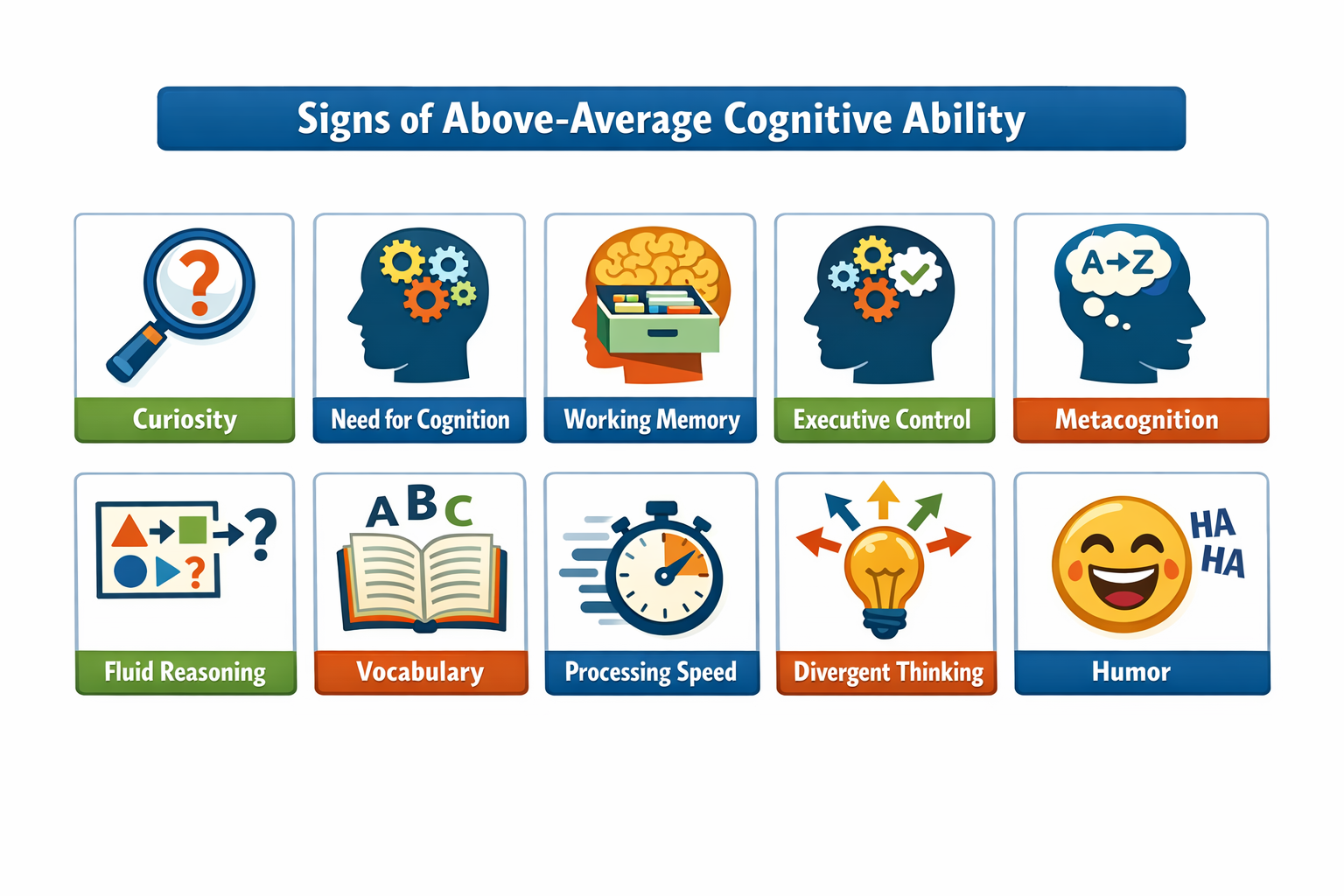
1. You’re reliably curious (and not just when it’s convenient).
People who score higher on traits linked to intellectual engagement—especially Openness/Intellect—tend to show a small-to-moderate positive relationship with intelligence in large meta-analyses. Curiosity matters partly because it increases exposure to knowledge and cognitive challenges, which can accumulate into stronger crystallized skills over time.
Self-check: Do you routinely chase explanations (“Why does this work?”) even when no one is grading you?
2. You enjoy effortful thinking more than most people do.
A large multi-level meta-analysis finds that Need for Cognition (the tendency to engage in and enjoy thinking) shows a positive overall association with intelligence. This “cognitive appetite” can function like mental strength training: not magical, but cumulative when it drives repeated practice with complex ideas.
Self-check: When faced with a tricky problem, do you feel pulled in rather than instantly bored or irritated?
3. You can hold multiple ideas in mind and work with them.
Working memory capacity and fluid intelligence are strongly related in many studies, and several models treat executive attention as a shared ingredient behind both. Importantly, the relationship is substantial but not identical.
Self-check: Can you track a few constraints at once (rules, exceptions, goals) without constantly “dropping the thread”?
4. You regulate attention and impulses to stay goal-directed.
Executive functions help you resist distractions, inhibit impulsive responses, and adapt strategies—skills closely tied to complex cognition in everyday life. Research also suggests executive functions are not one monolithic ability.
Self-check: When you notice distraction, can you redirect yourself without needing a crisis (or three coffees) to do it?
5. You notice when you might be wrong—and you can course-correct.
Metacognition (monitoring what you know and controlling what you do next) is often described as a bridge between raw cognitive skills and real-world expressions of intelligence. Research on self-assessment errors shows that people with weaker skills sometimes overestimate themselves partly because they cannot recognize mistakes.
Self-check: After giving an answer, do you naturally ask, “What would change my mind?” or “How could this be wrong?”
6. You’re good at solving novel problems—not just repeating learned steps.
Fluid intelligence is commonly described as reasoning with new information and solving problems that can’t be handled by memorized knowledge alone. Brain research reviews link intelligence differences to parieto-frontal pathways, suggesting that high-level reasoning depends on coordinated integration of information.
Self-check: When the “usual recipe” fails, can you invent a workable approach rather than freezing or guessing?
7. You use language precisely.
Vocabulary knowledge is often treated as a strong indicator of crystallized intelligence. Reviews note that verbal ability tests tend to be highly connected with general mental ability, though language is influenced by education and cultural exposure.
Self-check: Do you find yourself reaching for the right word because it changes the meaning—and you care about that?
8. You process simple information efficiently.
Mental speed measures are significantly correlated with intelligence, although the size and interpretation of correlations depend on the task. Faster thinking can support complex cognition, but speed alone does not explain intelligence.
Self-check: In everyday tasks (reading, sorting choices, basic reasoning), do you tend to reach correct answers quickly and consistently?
9. You generate multiple plausible ideas.
Research shows a positive relationship between intelligence and divergent thinking (a component of creative potential), with correlations around r ≈ .25 across many studies. Creativity is related to intelligence but clearly not identical to it.
Self-check: When brainstorming, can you produce several distinct approaches rather than many small variations of the same idea?
10. You “get” nuanced humor.
Humor ability—particularly generating humor—has been linked to measures of general and verbal intelligence in some studies. Humor often requires rapid reframing, pattern detection, and linguistic inference.
Self-check: Do you enjoy jokes that depend on hidden structure (double meanings, misdirection, perspective flips) more than purely physical comedy?
Misconceptions and what these signs are not
The biggest mistake is treating any single sign as proof of intelligence—or treating intelligence as a moral achievement. Standardized scores are statistical comparisons, not a spiritual ranking system. Many real strengths also lie outside classic psychometric testing, and outcomes are shaped by schooling quality and life context.
| Sign | What it indicates | Common misconception |
|---|---|---|
| Curiosity | More exploration and learning | Curious people must be extroverted |
| Enjoying thinking | Higher engagement with complex ideas | Thinking lovers are automatically good at math |
| Working memory | Strong mental workspace | Good memory means photographic memory |
| Executive control | Staying goal-directed | Self-control is only personality |
| Metacognition | Better error detection | Smart people are always confident |
| Fluid reasoning | Solving novel problems | Smart equals knowing trivia |
| Vocabulary | Strong crystallized knowledge | Big vocabulary means intelligence everywhere |
| Processing speed | Efficient cognitive operations | Fast answers are always better |
| Divergent thinking | Idea generation ability | Creativity equals genius |
| Humor ability | Cognitive flexibility | Funny people aren’t serious thinkers |
How these signs interact
Many of these traits reinforce each other through feedback loops:
-
Cognitive capacity supports learning
-
Learning builds knowledge
-
Curiosity increases engagement with learning
-
Metacognition improves how effectively we learn and correct mistakes
Education itself also appears to raise intelligence test performance in many studies, suggesting cognitive ability can develop with experience and training.
flowchart LR
A[Curiosity & Openness] --> B[More cognitive engagement]
B --> C[More learning experiences]
C --> D[Crystallized knowledge (Gc)]
E[Working memory + executive control] --> F[Fluid problem solving (Gf)]
F --> C
G[Metacognition] --> C
G --> B
H[Processing speed] --> E
I[Divergent thinking] --> F
D --> J[Nuanced communication & humor]
Conclusion and actionable takeaways
If you recognize several of these signs, the most reasonable interpretation is simply that your mind tends to enjoy and handle complexity. Intelligence scores predict learning and performance to some extent, but habits, environment, and opportunities remain extremely important.
Practical ways to strengthen cognitive ability:
-
Increase learning inputs: read challenging material, take courses, and practice difficult skills.
-
Train metacognition: check your confidence, analyze mistakes, and test alternative explanations.
-
Protect executive resources: reduce distractions during demanding tasks.
-
Balance speed with verification: quick thinking helps, but careful reasoning matters more.
Related Articles
Why Intelligent People Love Logic Puzzles
March 8, 2026
Why IQ Tests Lean So Heavily on Pictures
March 8, 2026


Comments