Executive Summary
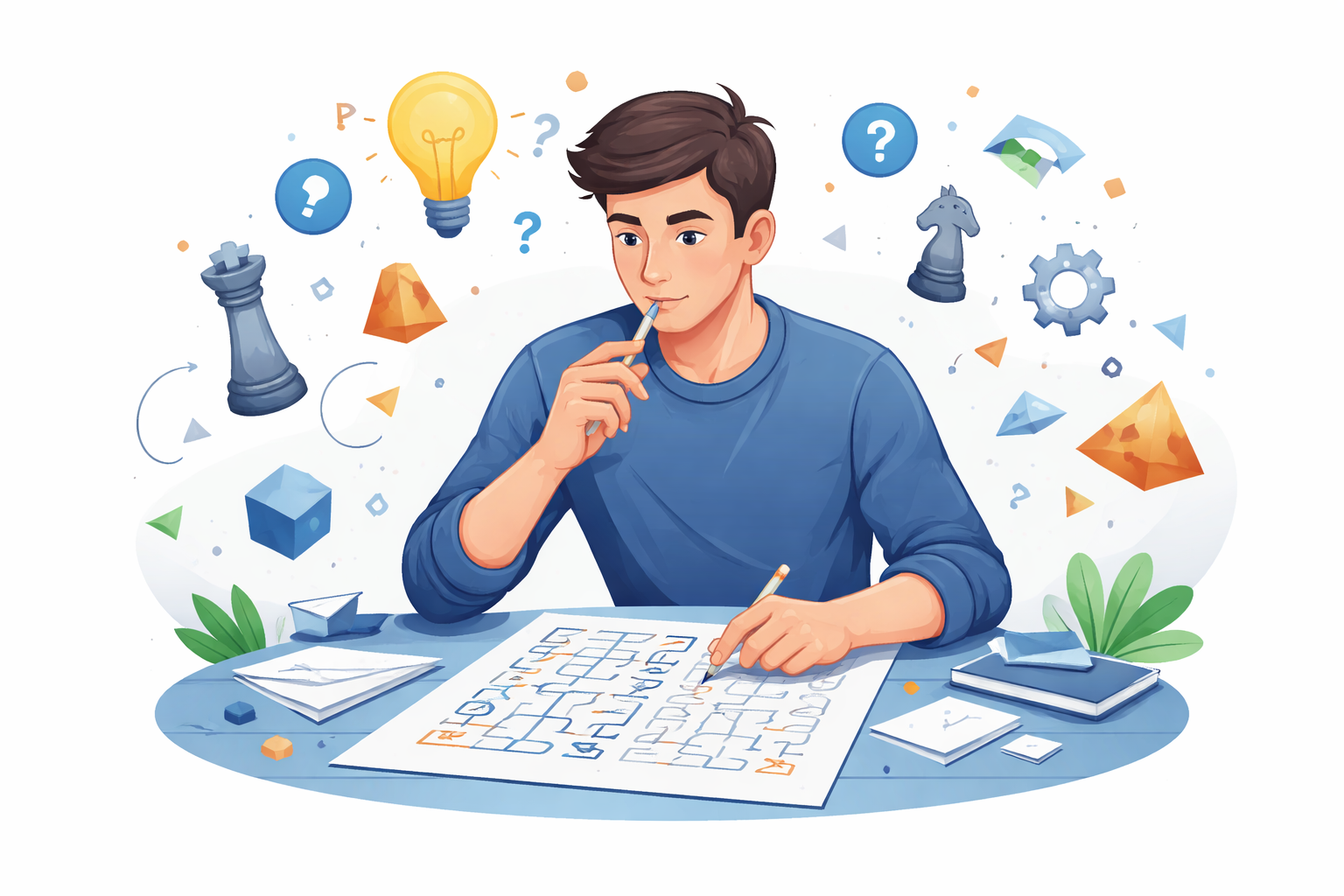
Logic puzzles are a “high-reward, low-stakes” way to think hard on purpose: you get clear goals, immediate feedback, and a satisfying moment of resolution—all without real-world consequences. Research suggests several overlapping drivers. First, puzzles align with intrinsic motivation and the basic psychological needs for competence and autonomy described in self-determination theory: you choose the challenge and get to feel yourself improving. Second, puzzles exploit curiosity, especially the “information gap” feeling—when you can almost see the answer, not knowing becomes mildly uncomfortable in a way that motivates exploration. Third, puzzles are structured to promote flow—deep absorption that happens when difficulty matches skill.
Cognitively, puzzles recruit working memory, attention control, pattern learning, and metacognition (monitoring your own thinking). The evidence is strongest for task-specific gains and improved problem-solving habits; broad “IQ boosts” from puzzles alone are not consistently supported in brain-training research.
If “intelligent people” is undefined (it is), a practical interpretation is: people with higher cognitive ability and/or higher cognitive motivation (e.g., “need for cognition”) may be more likely to enjoy puzzles. Associations between need for cognition and intelligence are statistically reliable but modest.
Introduction
Think about the last time a puzzle “clicked.” One second you’re stuck, the next your brain does a little internal victory lap—like it just found your missing keys and solved a mystery novel at the same time. That feeling isn’t accidental. Many puzzles are engineered to be maximally engaging: they sit right at the edge of your current ability, drip-feed partial progress, and make the final solution feel both inevitable and surprising.
This post digs into why puzzles are especially appealing to people who enjoy thinking deeply—whether that’s because they have high cognitive ability, high curiosity, a strong preference for mental challenge, or all of the above. The short version: puzzles are a safe playground where the mind gets to practice being powerful.
Psychological Motives
Intrinsic motivation and self-determination
A big reason puzzles hook people is that they are intrinsically motivating: the activity is rewarding in itself, not just for external payoff. Self-determination theory proposes that intrinsic motivation is supported by satisfying needs for competence (feeling effective), autonomy (feeling in control of choices), and relatedness (feeling connected). Puzzles reliably deliver the first two, and sometimes the third when solved with others.
A well-designed puzzle essentially whispers: “You can do this; prove it.” Every correct inference is a small competence signal, and the ability to pick your puzzle (easy/medium/hard) reinforces autonomy.
Curiosity and the itch of the information gap
Curiosity isn’t just a pleasant feeling—it can function like a drive state. George Loewenstein famously framed curiosity as arising when you notice a gap between what you know and what you want to know—an “information gap” that creates a motivating tension.
Puzzles exploit that tension expertly: they give you just enough information to see that a solution exists, but not enough to reach it immediately. That “almost there” sensation is the engine that keeps you turning the problem over in your head—sometimes in the shower, sometimes at 2 a.m., sometimes during a meeting you absolutely promised yourself you’d pay attention to.
Flow: the pleasure of being fully absorbed
Mihaly Csikszentmihalyi described flow as a state of deep engagement when challenge and skill are well matched, attention is fully invested, and time may feel distorted. Puzzles are unusually good at producing flow because they are:
-
clear about the goal (“fill the grid,” “find the culprit,” “prove the statement”),
-
rich in feedback (each deduction either fits or it doesn’t),
-
adjustable in difficulty (you can level up).
Competence, mastery, and “I knew I could get it”
Enjoyment intensifies when you can attribute success to your own skill and strategy—what psychologists often call competence or mastery experiences. Self-determination theory explicitly links competence satisfaction with enhanced motivation. A puzzle’s fairness matters here: if it feels solvable by reasoning rather than by guessing, solvers are more likely to feel that success reflects genuine competence.
Cognitive Benefits and Limits
Working memory and attention control
Logic puzzles require you to hold constraints in mind, update them, and resist distractions—classic working-memory and executive-attention demands. Reviews and syntheses in cognitive psychology link working memory capacity closely (though not identically) to reasoning and fluid cognitive performance.
In practical terms, when you do a logic grid puzzle, you’re constantly doing working-memory operations: “If A can’t be with X, and X must be with B, then…” That is mental juggling—with rules.
Pattern recognition and “chunking”
Some puzzle skills become faster because you stop seeing raw pieces and start seeing patterns. In expertise research, chess provides the classic example: stronger players remember meaningful positions better because they perceive structured “chunks,” not isolated pieces.
Puzzles can cultivate similar pattern libraries: Sudoku solvers learn common constraint patterns; riddle solvers learn to check linguistic ambiguity; lateral thinkers learn to test hidden assumptions. This isn’t magical—it’s learned structure recognition.
Metacognition: learning how you think
Metacognition—monitoring and regulating your own thinking—has been described as a foundational component of effective learning and problem solving. Puzzle solving naturally encourages metacognition because getting stuck forces questions like:
-
“What am I assuming?”
-
“What do I actually know for sure?”
-
“Is there a more systematic strategy?”
This aligns with the reflective “look back” mindset popularized in How to Solve It by George Polya, which emphasizes analyzing methods after reaching a solution.
A crucial reality check on “brain training”
It’s tempting to claim puzzles make you broadly “smarter.” The evidence is more nuanced. Large studies and meta-analytic reviews of cognitive training often find improvements on the trained tasks but limited “far transfer” to general intelligence measures or everyday cognitive function.
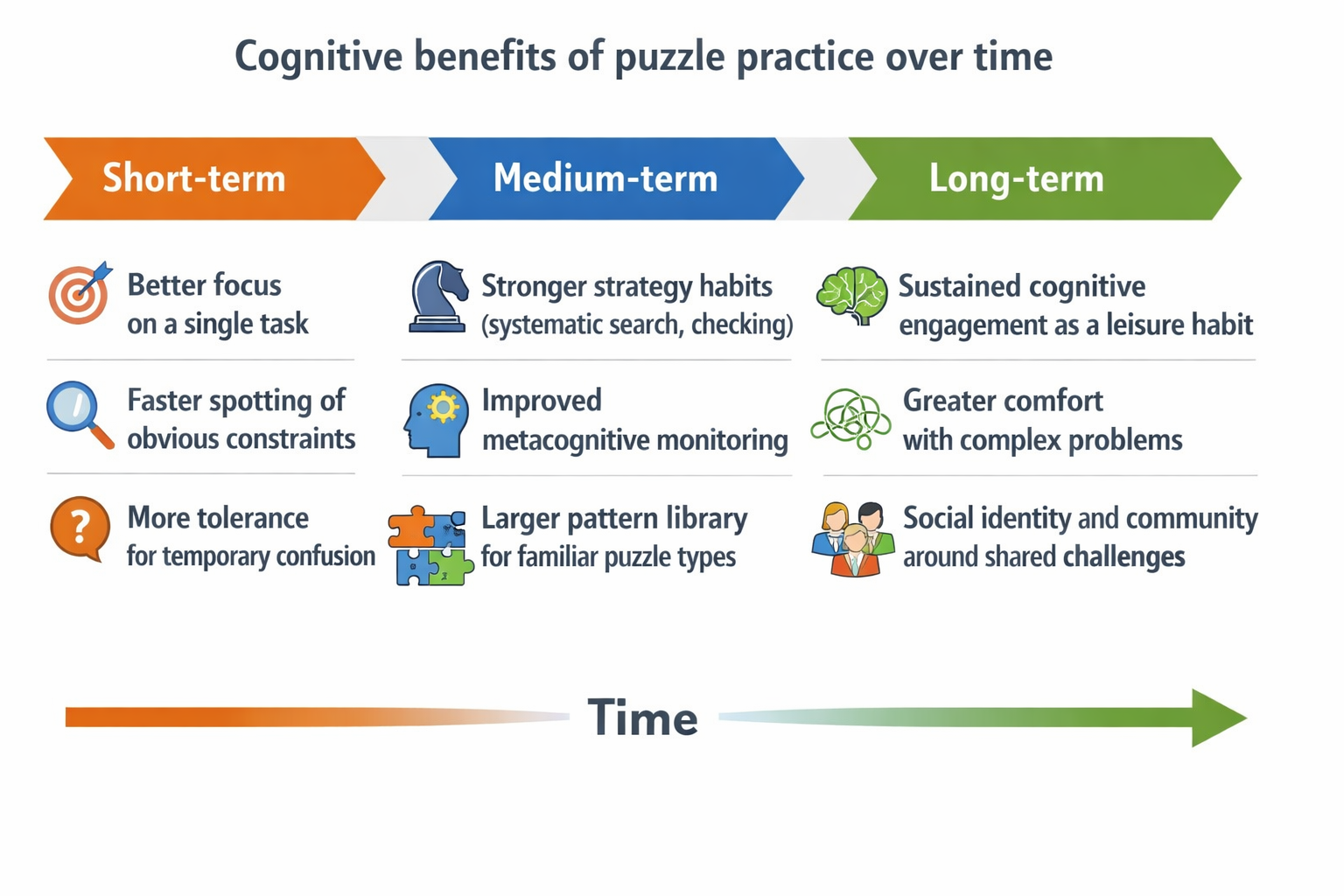
That doesn’t mean puzzles are pointless. It means their strongest benefits are likely:
-
near transfer (you get better at similar puzzles/skills),
-
stronger habits of structured thinking and persistence,
-
possibly long-term cognitive engagement benefits that are difficult to prove causally in short experiments.
Comparing common logic puzzle types
| Puzzle type | Cognitive skills trained (typical) | Typical difficulty range | Typical time required | Typical audience |
|---|---|---|---|---|
| Sudoku | constraint tracking, working memory updating, error checking, pattern spotting | easy → expert | 5–45 min | broad; popular with routine-lovers and pattern learners |
| Logic grid | deduction, set relations, systematic elimination, metacognition | medium → hard | 10–60 min | fans of structured reasoning (often STEM-leaning, but not only) |
| Lateral thinking | assumption testing, reframing, creative search, ambiguity tolerance | easy → very hard | 2–20 min | people who enjoy “aha” twists and social discussion |
| Riddles | semantic flexibility, pragmatic reasoning, memory retrieval, misdirection detection | easy → hard | 1–10 min | broad; strong “shareability” for groups and online |
The Neuroscience of the Aha Moment
Reward systems and dopamine: why solutions feel good
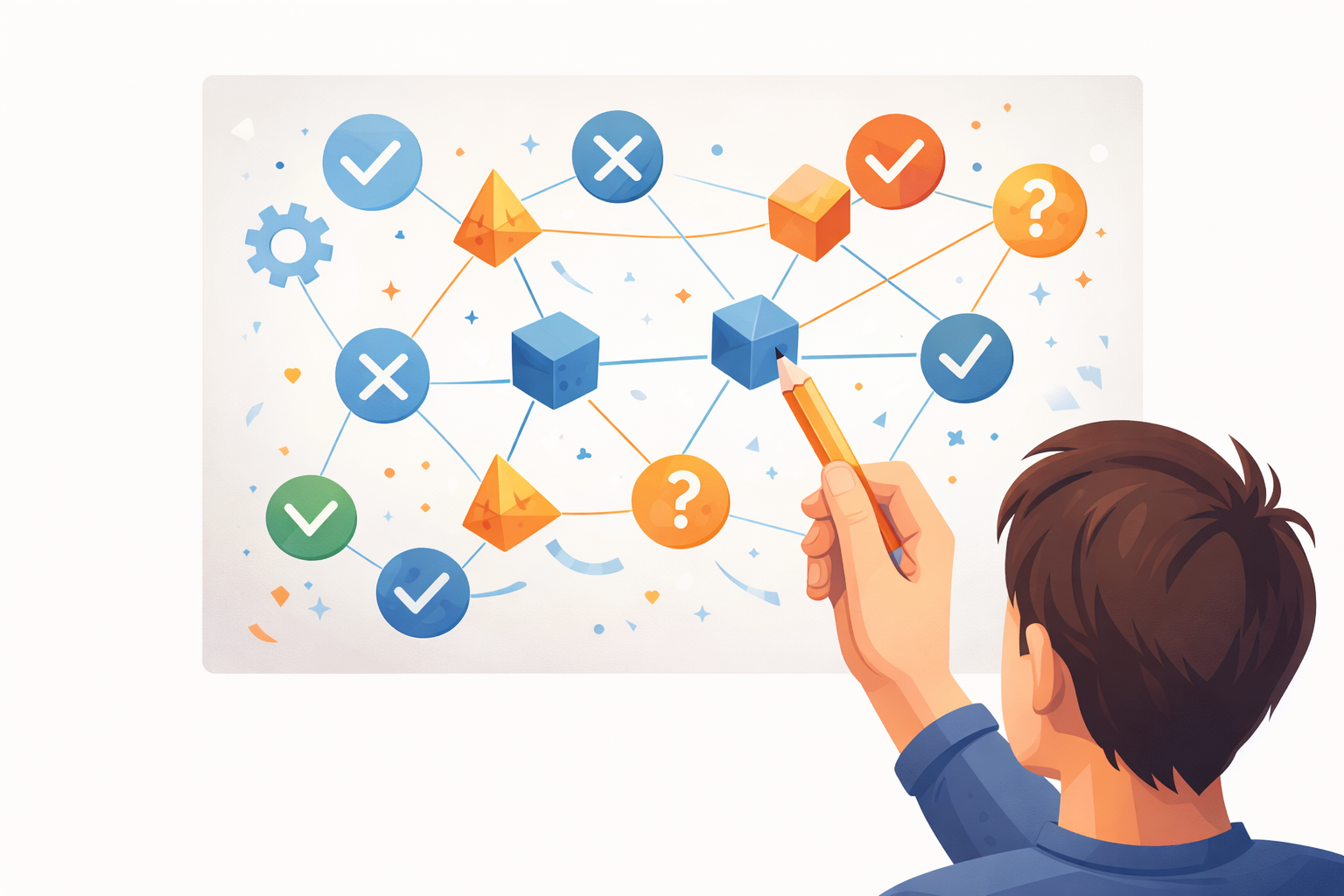
From a neuroscience perspective, puzzle pleasure is tied to how the brain learns from outcomes. Dopamine neurons are well known for signaling reward prediction errors—the mismatch between expected and received outcomes—which helps drive learning and motivation. Wolfram Schultz is closely associated with this framework in classic work on prediction and reward.
Puzzles are basically prediction-error machines: you form hypotheses, test them, get feedback (sometimes immediate), and update expectations. When the final inference lands, your prediction error collapses into a clean “yes,” which can be reinforcing.
Insight has a measurable reward signature
Insight (“Aha!”) isn’t just a vibe. Neuroimaging and electrophysiology studies associate insight experiences with activity in reward-related circuitry, including the nucleus accumbens, and with distinct neural signatures during problem solving.
Notably, a paper on an “insight-related neural reward signal” reported evidence consistent with insight being inherently rewarding—helping explain why many people voluntarily seek insight-generating activities like puzzles.
Prefrontal cortex and reasoning control
Reasoning-heavy tasks commonly recruit frontal and parietal systems involved in cognitive control and relational integration. fMRI studies using matrix reasoning problems (similar in spirit to many logic puzzles) show activation patterns consistent with this frontoparietal involvement.
Dopamine also plays key roles in prefrontal cognitive control—supporting functions like maintaining and manipulating working-memory contents—making it plausible (as an inference from established mechanisms) that puzzle engagement feels good partly because it aligns reward learning with cognitive control demand.
Education, Culture, and the Puzzle Ecosystem
Puzzles are not just private hobbies; they’re also cultural artifacts and teaching tools. Educational approaches that embed puzzles into STEM learning argue that puzzles emphasize how you approach problems, not just the final answer—encouraging strategy, reflection, and persistence.
In language learning and professional education contexts, studies have examined puzzles (like crosswords) as tools for vocabulary acquisition and engagement, often finding positive learning outcomes in specific settings.
Culturally, puzzles also signal identity: being “a puzzle person” can become a socially reinforced role. Once your environment rewards clever solutions—classrooms, competitive circles, friend groups—puzzles become both entertainment and belonging. Evidence from group problem solving shows that collaboration can improve outcomes on complex problems, reinforcing the social appeal of puzzle-solving together.
Personality and Individual Differences
Two traits are especially relevant to who enjoys puzzles:
Need for cognition (NFC). John T. Cacioppo and Richard E. Petty introduced NFC as a measure of a person’s tendency to engage in and enjoy effortful thinking. A recent multi-level meta-analysis reports small-to-moderate associations between NFC (and related “typical intellectual engagement”) and intelligence components, suggesting that people who enjoy thinking are somewhat more likely to have higher cognitive ability—though the relationship is far from perfect.
Openness/Intellect. Research splitting Openness into facets often finds the “Intellect” aspect is more directly associated with cognitive ability and intellectual engagement than aesthetic/perceptual openness alone.
Put simply: some people get more mental “fun” per unit effort. That doesn’t make them better humans—it just means puzzles are a more efficient form of recreation for their particular motivational wiring.
Practical Implications, Examples, and Further Reading
How to use puzzles for learning, productivity, and social bonding
For learning: use puzzles to practice the form of thinking you want, not vague “brain training.” Puzzle-based learning resources emphasize selecting tasks that require explanation, strategy, and reflection, not just speed. Pair puzzles with brief reflection (“What was my key inference?”) to strengthen metacognition.
For productivity: puzzles can be a controlled way to rehearse focus and persistence. The flow framework predicts that matching challenge to skill and having clear goals makes deep engagement more likely.
For social bonding: puzzles create a cooperative target. Experiments and models of group problem solving suggest teams can outperform individuals on complex tasks, and diversity in approaches can be beneficial.
Two short case studies
Case study: cognitively stimulating leisure and aging (observational). A 2003 longitudinal study of older adults reported that participation in cognitive leisure activities (including crosswords) was associated with lower risk of dementia. This is correlational (not proof that crosswords “prevent” dementia), but it illustrates why many people view puzzles as “exercise for the mind,” especially across the lifespan.
Case study: teams solving hard problems. Reports summarizing experimental work suggest that small groups (e.g., 3–5 people) can outperform even the best individual on complex problem solving, highlighting a practical reason puzzle nights and escape-room-style challenges feel so satisfying: the reward becomes collective.
Illustrative logic puzzles with solutions
Mini Sudoku (4×4)
Fill the grid so each row/column has 1–4, and each 2×2 box has 1–4.
Grid (0 = blank):
Row1: 1 0 0 4
Row2: 0 4 0 0
Row3: 0 0 4 0
Row4: 4 0 0 2
Solution:
Row1: 1 2 3 4
Row2: 3 4 2 1
Row3: 2 1 4 3
Row4: 4 3 1 2
Logic grid mini-puzzle (three people, three puzzles)
Ada, Ben, and Chen each did one puzzle: Sudoku, Logic Grid, or Riddle.
Clues:
-
Ada didn’t do Sudoku.
-
Ben didn’t do the Riddle.
-
Chen didn’t do the Logic Grid.
Question: Who did what?
Solution:
-
If Ben can’t do Riddle, Ben is either Sudoku or Logic Grid.
-
Chen can’t do Logic Grid, so Chen is Sudoku or Riddle.
-
Ada can’t do Sudoku, so Ada is Logic Grid or Riddle.
Try Ben = Logic Grid ⇒ Chen can’t be Logic Grid, so Chen = Sudoku or Riddle. If Chen = Sudoku, then Ada must be Riddle (fits clue 1). All constraints satisfied.
Answer: Ben = Logic Grid, Chen = Sudoku, Ada = Riddle.
Lateral thinking riddle
“A woman pushes her car to a hotel and loses her fortune. Why?”
Solution: She’s playing Monopoly.
Mermaid timeline of benefits from puzzle practice
Related Articles
Why IQ Tests Lean So Heavily on Pictures
March 8, 2026
Signs You May Be Smarter Than Average
March 8, 2026


Comments