
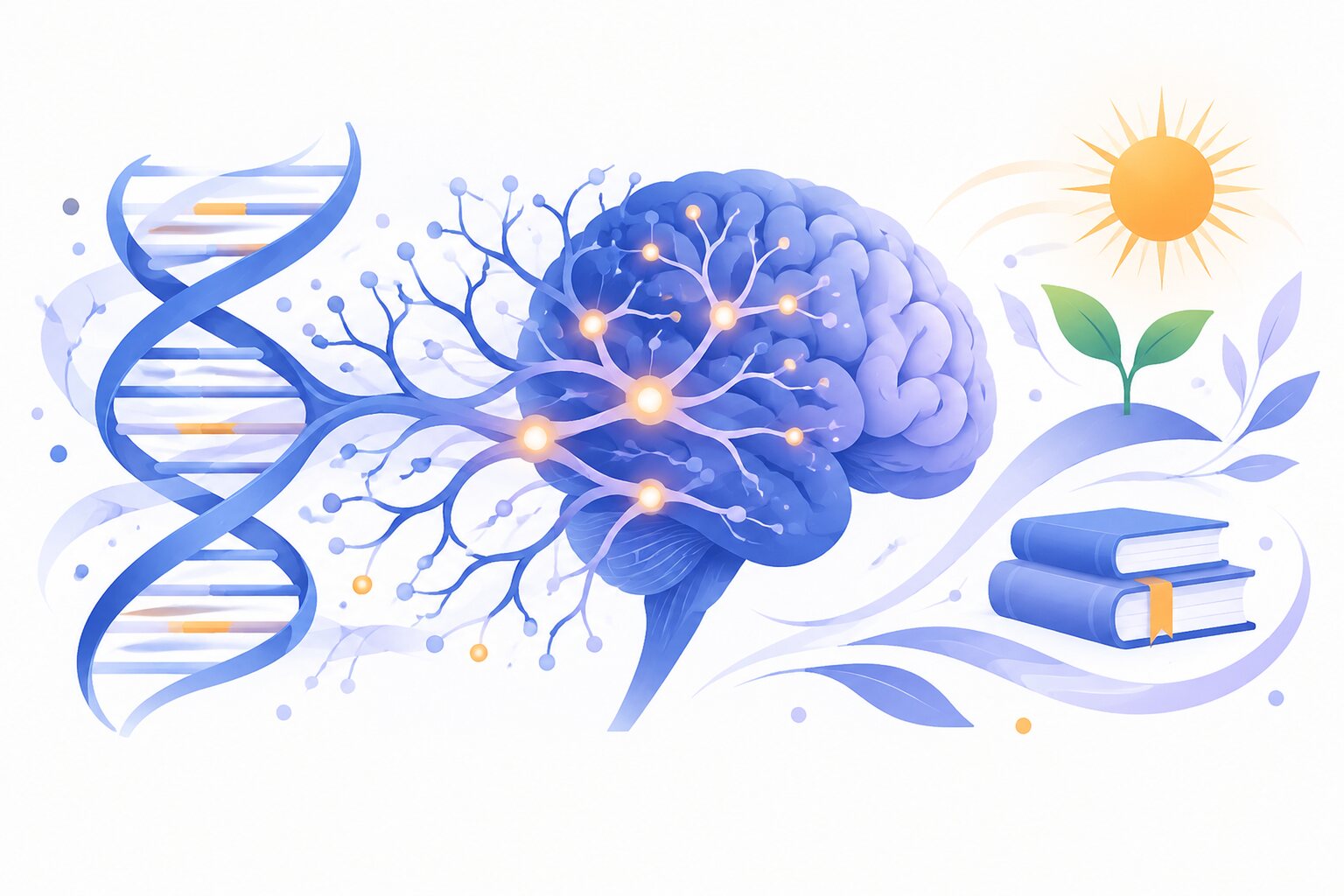
Is intelligence inherited from your parents, or shaped by how you grow up? The scientific answer is both. Twin and adoption studies consistently find that genetic differences explain a substantial share of the differences in IQ between people, roughly half in adulthood by many estimates. But "heritable" does not mean "fixed", and environment clearly matters too.
This article explains what the research actually shows, what heritability does and does not mean, and why the genetic influence on IQ surprisingly grows stronger with age.
Is IQ genetic? The short answer
- Genes account for a meaningful part of the differences in IQ between individuals.
- Estimates of heritability rise from about 20% in infancy to somewhere between 50% and 80% in adulthood, depending on the study.
- There is no single "intelligence gene". Thousands of genetic variants each contribute a tiny effect.
- Environment, including education, nutrition and health, also has measurable effects on IQ.
What heritability really means
Heritability is one of the most misunderstood ideas in psychology. It is a statistic about a population, not about an individual. A heritability of 50% means that, in a particular group of people at a particular time, about half of the variation in IQ scores is associated with genetic differences between them.
It does not mean that 50% of your intelligence comes from your genes and 50% from your upbringing. Genes and environment work together in every person, and the two cannot be separated into neat percentages for one individual.
Heritability can also change when circumstances change. If everyone in a society had equally good schools and nutrition, environmental differences would shrink, and the remaining differences would look more heritable, even though nothing about anyone's genes had changed.
How scientists study the genetics of IQ
Twin studies
Identical twins share virtually all of their genes, while fraternal twins share about half on average. If identical twins are consistently more alike in IQ than fraternal twins, that difference points to a genetic influence. Across many large twin studies, identical twins are indeed much more similar.
Adoption studies
Adopted children share genes with their biological parents but grow up with their adoptive families. Comparing them with both sets of parents helps separate the effects of genes and home environment. These studies show influences from both: adopted children resemble their biological parents in IQ more as they grow older, yet children adopted into more advantaged homes tend to score higher than would otherwise be expected.
DNA studies
Modern genome-wide studies involving hundreds of thousands of people have identified hundreds of genetic variants associated with intelligence. Each one has a tiny effect. Together, they confirm what twin studies suggested: intelligence is influenced by a very large number of genes, not a handful.
Why genetic influence increases with age
One of the most striking findings in this field is that the heritability of IQ increases as people get older. A review by psychologists Robert Plomin and Ian Deary in Molecular Psychiatry summarised it as rising from about 20% in infancy to perhaps 80% in later adulthood. Other studies report somewhat lower adult figures, but the upward trend is consistent. It is sometimes called the Wilson effect.
Why would genes matter more over time? A leading explanation is that as people grow up, they gain more control over their own environments. Children largely live in the world their parents choose for them. Adults choose their own jobs, hobbies, friends and reading, and those choices tend to reflect and reinforce their natural inclinations. You can read the Plomin and Deary review for more detail.
How environment shapes IQ
None of this means environment is unimportant. Several lines of evidence show it clearly:
- Education. A large 2018 meta-analysis by Stuart Ritchie and Elliot Tucker-Drob estimated that each additional year of education raises IQ by roughly 1 to 5 points.
- Rising scores over generations. IQ test scores rose substantially across the 20th century, a pattern known as the Flynn effect. Genes cannot change that quickly, so the gains must be largely environmental.
- Health and nutrition. Factors such as early nutrition, iodine sufficiency and avoiding toxins like lead are linked to cognitive development.
Genes and environment also interact. A child with a natural curiosity may seek out books and challenges, which in turn develops their abilities further.
Common misconceptions
"If IQ is genetic, it can't change"
Height is highly heritable too, yet average height has increased dramatically over the last century thanks to better nutrition. Heritability says nothing about whether a trait can be changed.
"Smart parents always have smart children"
Children of high-IQ parents tend to score above average, but often less extremely than their parents. Because so many genes are involved, each child inherits a new combination, and scores tend to drift back towards the average.
"Heritability explains differences between groups"
Heritability estimates describe variation within the group that was studied. They cannot, on their own, explain average differences between different groups, which may reflect very different environments.
What this means for you
Your genes may influence your starting point, but they do not write your story. Education, reading, curiosity and mentally demanding activities all support cognitive skills throughout life. Our guide to cognitive skills you can train every day is a good place to start, and you can learn more about the difference between fluid and crystallized intelligence.
Curious about your own cognitive profile? Take our IQ test to see your score and strengths across five areas of reasoning.