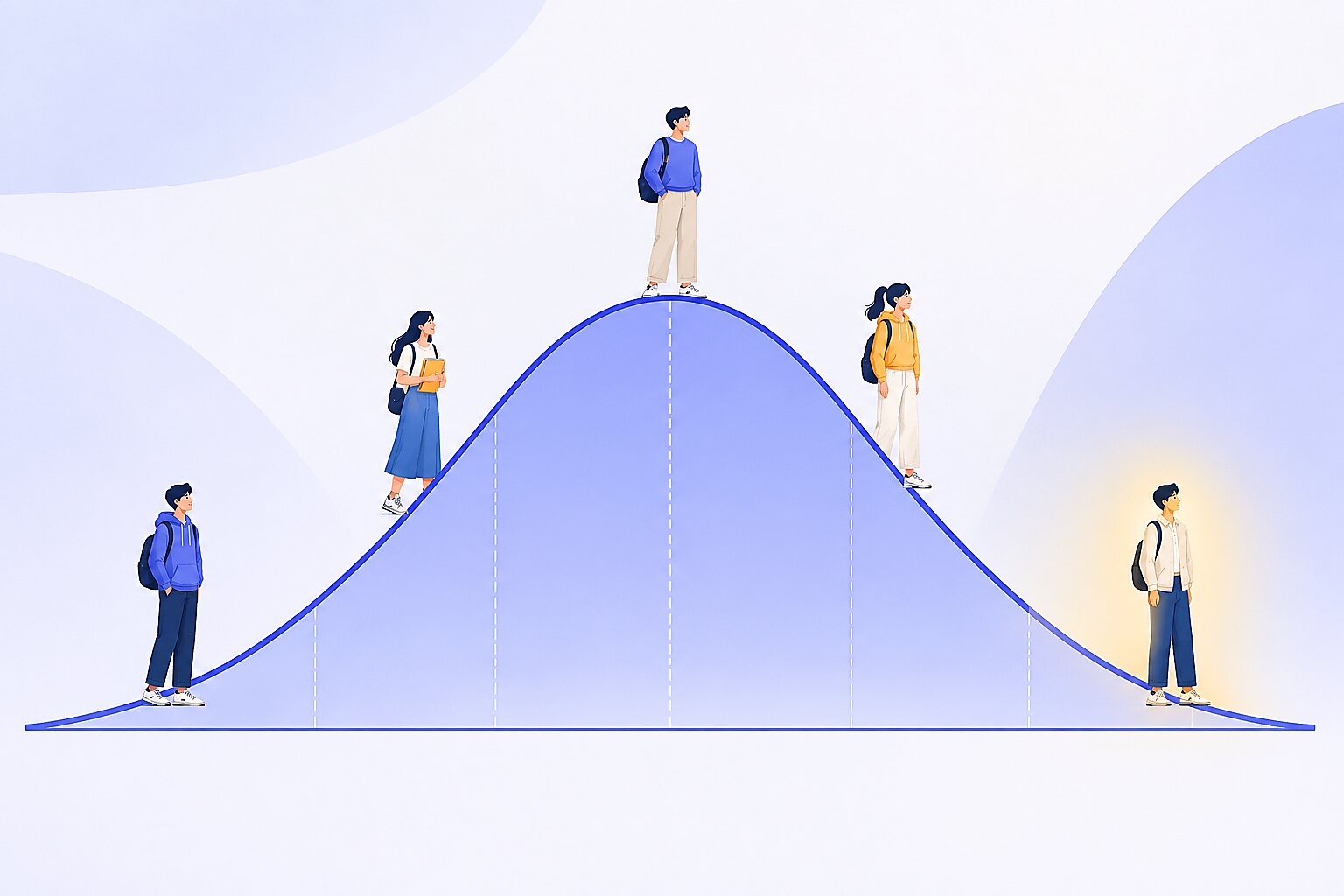

There is no official "genius" score on any modern IQ test. In everyday use, though, people usually mean an IQ of 140 or higher, a level reached by roughly 1 in 260 people. Some writers set the bar even higher, at 145 (about 1 in 740) or 160 (about 1 in 31,500).
Where do these numbers come from, and does a very high score actually make someone a genius? The history is more interesting than the label.
What IQ is considered genius?
Modern tests such as the Wechsler scales stop at descriptive labels like very superior (130 and above) or extremely high. None of them uses the word "genius". The popular thresholds come from history and convention:
| IQ score | Percentile | Roughly 1 in… | How it is commonly described |
|---|---|---|---|
| 130 | 98th | 44 | Very superior; typical high-IQ society threshold |
| 135 | 99th | 100 | Cut-off used in Terman's study of gifted children |
| 140 | 99.6th | 260 | The most common popular "genius" threshold |
| 145 | 99.87th | 740 | Three standard deviations above average |
| 160 | 99.997th | 31,500 | Four standard deviations; often called "profoundly gifted" |
All figures assume the standard IQ scale with an average of 100 and a standard deviation of 15. See our IQ percentile chart for the full conversion.
Where the 140 "genius" threshold comes from
Lewis Terman, the Stanford psychologist who adapted Alfred Binet's test into the Stanford-Binet in 1916, published one of the first classification schemes for IQ scores. In it, scores above 140 were described as "near genius or genius". The label stuck in popular culture long after psychologists stopped using it.
Terman then put the idea to the test. In 1921 he began a long-term study of more than 1,500 Californian children with IQs of 135 or above, published as Genetic Studies of Genius. He followed them for decades.
What Terman's "geniuses" actually achieved
On average, the children in Terman's study did very well. They tended to be healthier, better educated and more professionally successful than the general population. Many became doctors, lawyers, professors and scientists.
But the study is also famous for who it missed. Two boys who were tested but did not make the cut, William Shockley and Luis Alvarez, both went on to win the Nobel Prize in Physics. None of the children selected for the study did.
A 2018 analysis in the journal Intelligence argued that this is less damning than it sounds: Nobel prizes are so rare that even a group of very bright children would be unlikely to produce one. Still, the lesson is clear. A high IQ raises the odds of outstanding achievement, but it is neither necessary nor sufficient for it.
IQ is not the same as genius
When we call someone like Marie Curie or Leonardo da Vinci a genius, we are describing what they did, not a test result. Exceptional achievement usually combines several ingredients:
- High cognitive ability, which IQ tests capture reasonably well.
- Deep expertise built over years of focused practice in one field.
- Creativity, which is related to IQ but far from identical. We explore this in IQ and creativity: a complicated relationship.
- Persistence and motivation, often the deciding factor between talent and accomplishment.
- Opportunity: education, mentors and the right problem at the right time.
Curious how famous minds might have scored? Read how Einstein, Da Vinci and Curie might fare on today's IQ tests. Keep in mind that IQ figures quoted for historical figures are estimates, not measured scores.
How rare are very high IQ scores?
Because IQ follows a bell curve, each step up the scale becomes dramatically rarer. Moving from 130 to 145 shrinks the group from about 1 in 44 to 1 in 740. Moving to 160 shrinks it to about 1 in 31,500.
At these extremes, measurement also becomes less precise. Most standard tests are designed to be most accurate near the middle of the scale, and very few people in the norming sample score at the top, so scores above about 150 carry larger margins of error. Claims of IQs of 200 or more, often repeated online, are not meaningful on modern deviation-IQ tests.
Frequently asked questions
Is 130 a genius IQ?
A score of 130 places you in roughly the top 2%, which is classed as very superior and qualifies for Mensa on most approved tests. Most people would call it gifted rather than genius, but there is no official cut-off.
Is 140 a genius IQ?
140 is the threshold most often associated with "genius", largely thanks to Terman's early classification. It corresponds to about the top 0.4% of the population.
What is the highest possible IQ?
There is no fixed maximum, but most modern tests are not designed to measure reliably much above 150 to 160. Very high published scores usually come from older ratio-IQ tests or unverified sources.
Wondering where you fall on the scale? Take our IQ test to see your score, or learn more about IQ scores and IQ levels.