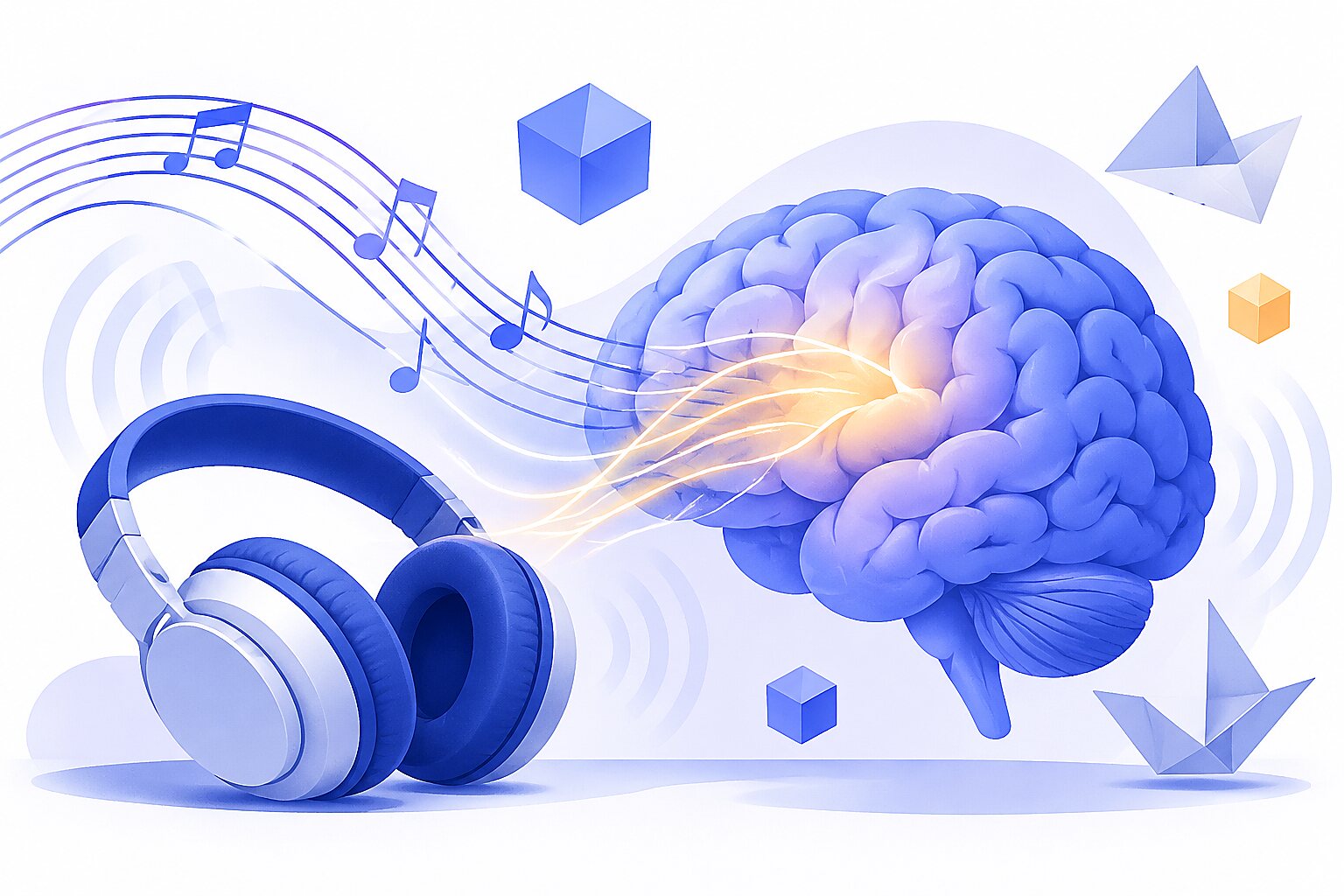
In the late 1990s, parents were told that playing Mozart to their babies would make them smarter. The idea spread so fast that one US state proposed giving classical music CDs to every newborn. But does listening to Mozart really raise your IQ? The short answer is no. The original study found a small, brief boost on a specific spatial task, and later research showed that almost any music you enjoy can produce the same effect.
Here is how the "Mozart effect" began, what the evidence actually says, and where music genuinely can help your brain.
Where the Mozart effect came from
In 1993, researchers Frances Rauscher, Gordon Shaw and Katherine Ky published a short paper in the journal Nature. College students who listened to about ten minutes of Mozart's Sonata for Two Pianos in D major performed better on spatial reasoning tasks than students who sat in silence or listened to relaxation instructions.
Three details were quickly lost in the retelling:
- The participants were adults, not babies.
- The improvement was on spatial tasks such as folding and cutting paper, not on general intelligence.
- The effect lasted only about 10 to 15 minutes.
Popular media turned this into "Mozart makes you smarter", and a booming market for classical music products for babies followed. In 1998, the governor of Georgia proposed a state budget item to give every newborn a classical music CD.
What the research actually shows
Once other scientists tried to repeat the experiment, the effect started to shrink.
- Many replication attempts found small effects or none at all.
- A 1999 meta-analysis by Christopher Chabris, also in Nature, concluded that any effect was small and limited to certain spatial tasks.
- A larger 2010 meta-analysis by Jakob Pietschnig and colleagues in the journal Intelligence, covering nearly 40 studies and more than 3,000 participants, found little evidence for a specific Mozart effect. Listening to other music produced a similarly small benefit, and studies from the original research group reported noticeably larger effects than independent labs.
The real explanation: arousal and mood
If Mozart is not special, why did people do slightly better on the tests? The most widely accepted explanation is the arousal and mood hypothesis, developed by psychologist E. Glenn Schellenberg and colleagues.
Music that you find pleasant and energising puts you in a better mood and a more alert state. Being alert and in a good mood helps performance on many tasks for a short time. In one experiment, people who preferred listening to a Stephen King audio story performed just as well after hearing it as others did after hearing Mozart. The benefit came from enjoyment, not from the composer.
That means the same short-term lift can come from a favourite song, a cup of coffee or anything else that wakes you up and lifts your mood.
Music lessons are a different story
Listening to music and learning to play it are not the same thing. There is some evidence that music lessons may have modest benefits for children.
In a 2004 study published in Psychological Science, Schellenberg randomly assigned 144 six-year-olds to a year of keyboard lessons, voice lessons, drama lessons or no lessons. The children who took music lessons gained about 2.7 IQ points more than the control groups on average.
That is a real but small effect, and later reviews urge caution. Most studies on music and intelligence are correlational, and children who take music lessons often differ from those who do not in other ways, such as family resources and motivation. Learning an instrument is wonderful for its own sake, but it is not a shortcut to a dramatically higher IQ.
What actually helps your thinking
If you want to perform at your best on a demanding mental task, the evidence points to some unglamorous basics:
- Sleep well. Even one poor night measurably affects attention and working memory.
- Stay physically active. Regular exercise supports overall brain health.
- Keep learning. Education and mentally demanding activities support cognitive skills over a lifetime.
- Get in the right state. If a favourite playlist helps you feel alert and positive before a task, use it. Just do not expect it to change your IQ.
For practical ideas, see our guides to cognitive skills you can train every day and tips to improve IQ test performance.
Frequently asked questions
Does listening to Mozart increase IQ?
No. Listening to Mozart can give a small, temporary boost on some spatial tasks, but so can other music you enjoy. It does not raise your IQ.
Does classical music help you study?
It may help if you find it relaxing and it does not distract you. Music with lyrics tends to interfere more with reading and verbal tasks. The best choice depends on the person and the task.
Do music lessons make children smarter?
Some studies find small IQ gains from music lessons in childhood, but the evidence is mixed and the effects are modest. Lessons are best valued for the skills and enjoyment they bring.
Want to see how your reasoning skills measure up, with or without a soundtrack? Take our IQ test.